
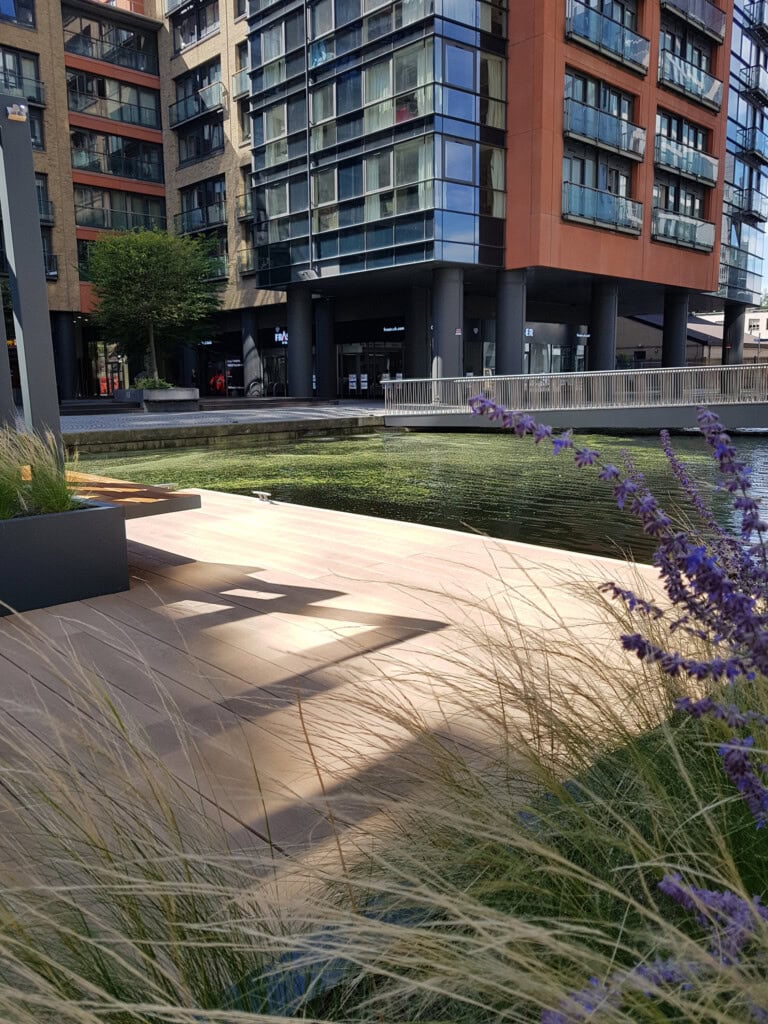
Floating Pocket Park, Paddington Basin
Floating Pocket Park
| Location | Paddington, London |
|---|---|
| Designer | Tony Woods / Garden Club London |
An inspired urban oasis, designed to reconnect Londoners with water and wellbeing.
The Brief
Create an authentic timber-look walkway and outdoor furniture solution that could withstand the challenges of a floating structure in a busy central London location, all while maintaining a premium aesthetic.
Project Overview
Location: Paddington Basin, London
Designer: Tony Woods, Garden Club London
Transforming an Urban Waterway
Once an overlooked corner of the Grand Union Canal, Paddington Basin has been reimagined as a thriving destination that blends engineering innovation with landscape artistry. The centerpiece of this rejuvenation is the Floating Pocket Park – London’s first public floating park – designed by RHS Young Garden Designer of the Year and Gold Medalist, Tony Woods of Garden Club London.
Part of the wider 4.45-hectare Merchant Square development, the Floating Pocket Park brings to life a pioneering concept: an accessible, biodiverse ‘blue space’ designed to enhance wellbeing in the heart of the capital. Built on a series of pontoon platforms, the park provides a peaceful retreat surrounded by water, greenery, and thoughtful detailing.
A New Kind of Green Space
The park was inspired by a 2016 report highlighting the positive effects of waterside living on mental and physical health. For Tony Woods, the findings reaffirmed the power of natural environments to restore calm and connection, even in the densest urban contexts.
His design captures this ethos perfectly. A network of walkways and seating areas weaves between lawns, planting beds and trees, creating a tranquil haven for residents, workers and visitors alike. Wildlife has also found a welcome home, with floating habitats and a dedicated ‘wildlife island’ providing sanctuary for birds, insects and aquatic species.
The result is both a feat of design and a symbol of how cities can integrate calmness and serenity into everyday spaces.
The Role of Millboard
From the earliest design stages, it was clear that the decking would need to meet exceptionally high demands – both aesthetically and technically. The structure’s constant exposure to moisture, coupled with the movement of the floating pontoons, meant that traditional timber simply wasn’t suitable.
“Real timber would not be able to meet the requirements of the space,”
explains Ben Dewhirst, Landscape Architect at Garden Club London.
“Many composite products simply looked cheap or unattractive.”
Millboard’s Enhanced Grain collection offered the ideal solution. Designed and made in the UK from a resin mineral composite material and hand-molded from the finest oak, each board captures the warmth and character of natural timber, without the high maintenance burden or risk of decay. The surface texture replicates the intricate grain detail of oak, while the proprietary Lastane® coating delivers exceptional slip resistance, even in wet conditions.
For a space where safety and visual harmony were equally vital, the choice was clear.
Design Integration and Performance
Millboard decking forms the foundation of the park’s raised walkways and seating zones, linking together the various floating platforms. The boards were chosen in a tone that complements the surrounding greenery and soft landscaping, creating a seamless visual flow from land to water.
Because the park is subject to constant environmental stresses – from heavy foot traffic to humidity and UV exposure – durability was non-negotiable. Millboard’s solid core and closed-cell structure mean it won’t absorb water, warp, or rot, ensuring lasting performance in this unique floating environment.
The low maintenance requirements were another major benefit. In a public space designed for year-round enjoyment, reducing the need for frequent demanding upkeep such as sanding, staining and sealing, supports both practicality and cost efficiency.
Innovation Rooted in Nature
By combining technical innovation with authentic beauty, Millboard products helped bring the designer’s vision to life: a space that looks and feels organic, yet stands up to the rigors of city life.
Public Response and Recognition
Since opening, the Floating Pocket Park has been celebrated for its originality and positive community impact. Visitors describe it as a hidden gem – a place where London’s fast pace gives way to stillness, and where nature feels close enough to touch.
The park has also attracted attention from the design community for its imaginative approach to placemaking. It demonstrates how creative thinking, supported by high-performance materials, can unlock new ways of living with water in urban settings.
Why Millboard decking?
- Authentic Aesthetic: Hand-molded from real oak for an unmistakably natural appearance.
- Exceptional Slip Resistance: Safe underfoot in all weathers – ideal for floating and waterside structures.
- Low Maintenance: No need for staining, sealing or painting.
- Durability: Won’t rot, warp or host algae, even in wet conditions.
A Lasting Impression
The Floating Pocket Park is a living, breathing example of how thoughtful design and material choice can enhance wellbeing in the city. It stands as proof that nature, practicality, and style can coexist beautifully, even in the most demanding environments.
Every detail, from the curve of the walkways to the organic grain detail of the boards, invites people to pause, breathe and reconnect. In Tony Woods’ hands, and with Millboard decking underfoot, a forgotten pocket of water has become one of London’s most uplifting urban escapes.

Floating Pocket Park, Paddington Basin

Hassocks home renovation
